completed projects
From our portfolio — street lighting
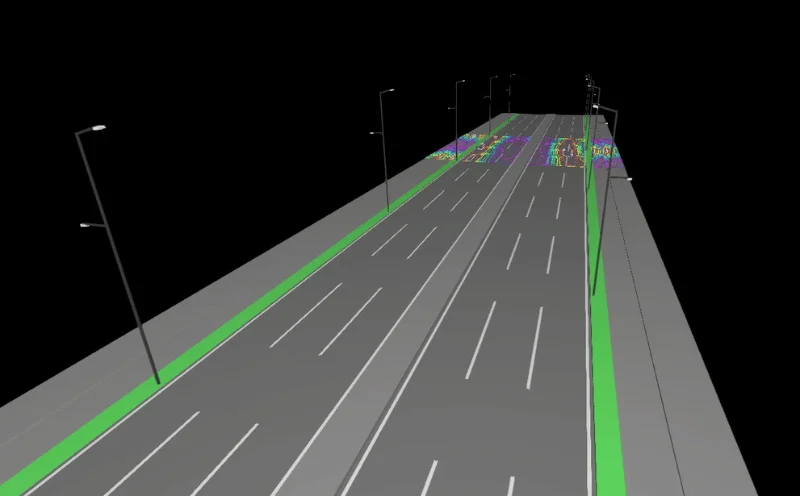
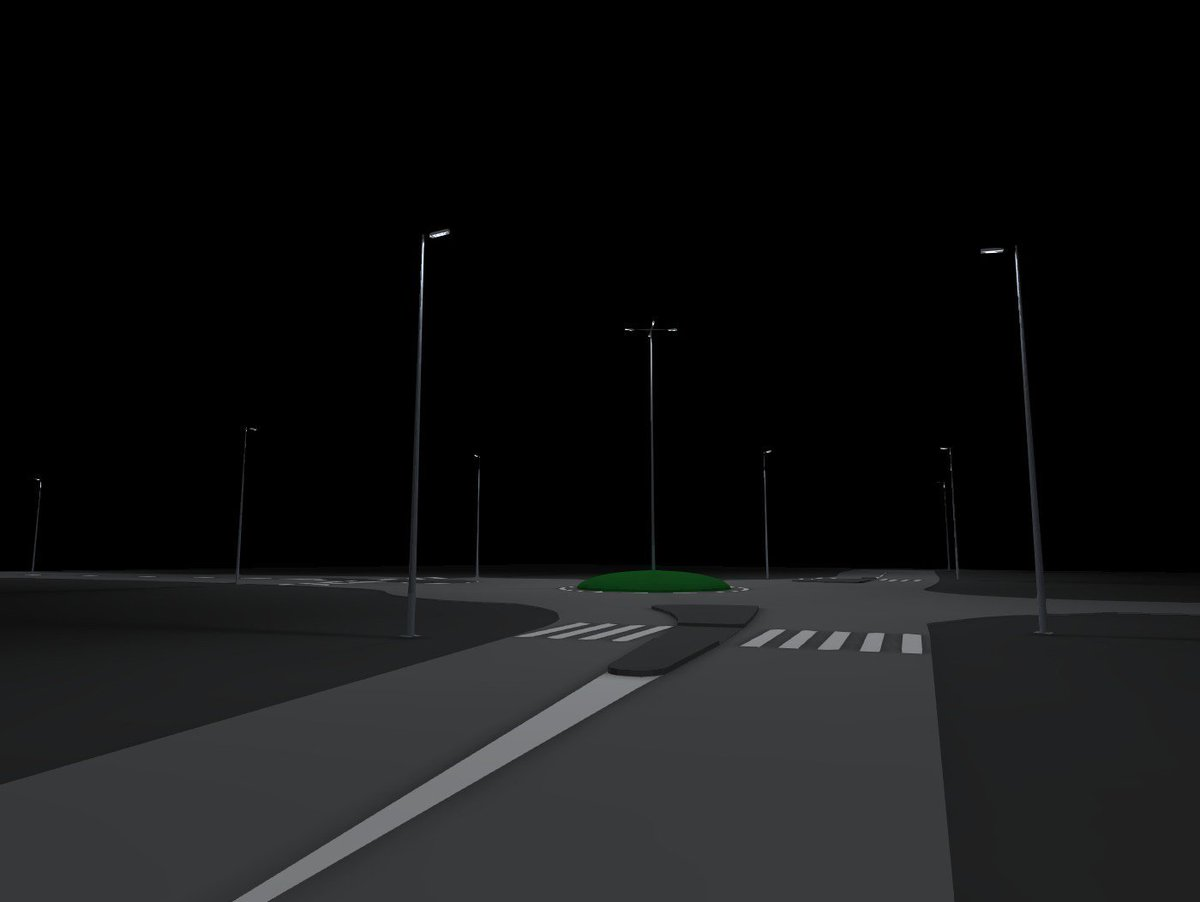
Full class tables with uniformity and glare limits: Lighting Standards in Romania →
Complete photometric studies for roads, streets, pedestrian areas and public spaces in DIALux Evo, with luminance and illuminance calculations, verified uniformity, energy indicators and pole layouts. Delivery in 24–72 hours.
Request a quotethe european reference standard
Road lighting is governed by the European EN 13201 series. It defines lighting classes based on road type, speed and traffic, and the photometric values each class must meet. Public projects and tenders require this compliance to be proven by calculation.
In DIALux Evo we model the exact road geometry — carriageway and footway widths, pole spacing, mounting height, overhang and tilt — and verify every EN 13201 parameter: average luminance (L̄), overall uniformity (Uo), longitudinal uniformity (Ul), threshold increment (fTI) and edge illuminance ratio (REI).
We also report energy performance to EN 13201-5 — the power density indicator (PDI) and annual energy consumption indicator (AECI) — and check upward light against the light-pollution rules of the project.
M1 (motorway, high speed): L̄ 2.00 cd/m²
M2 (main national road): L̄ 1.50 cd/m²
M3 (distributor road): L̄ 1.00 cd/m²
M4 (main local street): L̄ 0.75 cd/m²
M5 (residential road): L̄ 0.50 cd/m²
M6 (low-traffic road): L̄ 0.30 cd/m²
C0–C5 (intersections, roundabouts): Ē 50–7.5 lx
P1–P6 (pedestrian areas, cycle paths): Ē 15–2 lx
Send the road plan and receive the complete study in 24–72 hours. Quotes the same working day.
completed projects
Full class tables with uniformity and glare limits: Lighting Standards in Romania →
complete documentation
L̄, Uo, Ul, fTI and REI for M classes; average illuminance and uniformity for C and P classes.
Simulations of the light on carriageway and footways, with false-colour maps to check uniformity.
Class selection, lighting solution, installed power, annual energy use and the PDI / AECI indicators.
Wattage, luminous flux, road optic, colour temperature and IP rating of the recommended luminaires.
Pole positions and spacing, mounting height, recommended bracket and arrangement (single-sided, staggered, opposite).
Upward light output (ULOR) checked against the light-pollution rules of the municipality or country.
proven experience
simple and fast
DWG or PDF site plan with carriageway and footway widths and any obstacles. Tell us the road type, speed limit and, if known, the required lighting class.
We confirm the EN 13201 class, propose a pole and luminaire arrangement and send a quote the same working day.
Within 24–72 hours: EN 13201 calculations, renderings, pole layout, technical report and luminaire specifications.
frequently asked questions
Roads with motor traffic use M classes, chosen by speed, traffic volume and road function: typically M3–M4 for distributor and main local streets, M5–M6 for residential roads. Low-speed residential and pedestrian streets often use P classes. The class follows CEN/TR 13201-1; in Romania it is usually set in the tender documents, in line with NP 062.
Luminance (M classes) takes into account the road surface reflection and the driver’s viewpoint, and is the method EN 13201 uses for roads with motor traffic. Illuminance (C and P classes) is used for conflict areas, pedestrian zones and low-speed streets.
It depends on road width and the luminaire’s optic. As a rule of thumb, 6–8 m poles suit 6–8 m wide streets and 8–10 m poles suit roads 10–12 m wide. The calculation sets the exact height and spacing.
Yes. EN 13201 applies across Europe. Tell us the national requirements of the project country — class selection rules, light-pollution limits — and we design to them.
For standard road sections up to about 500 m, 24–48 hours. Projects with intersections, roundabouts or several pedestrian areas take 48–72 hours. The exact deadline comes with the quote.
Send us the road plan and receive a quote the same working day. Delivery in 24–72 hours.
Request a quote